Reflections on the Newcastle Culture Partnership consultation: a blog post by Annie Rigby
Annie Rigby reflects on a rich afternoon of conversation at Great North Museum: Hancock, with a full summary of themes from the North East Mayoral Strategic Authority.
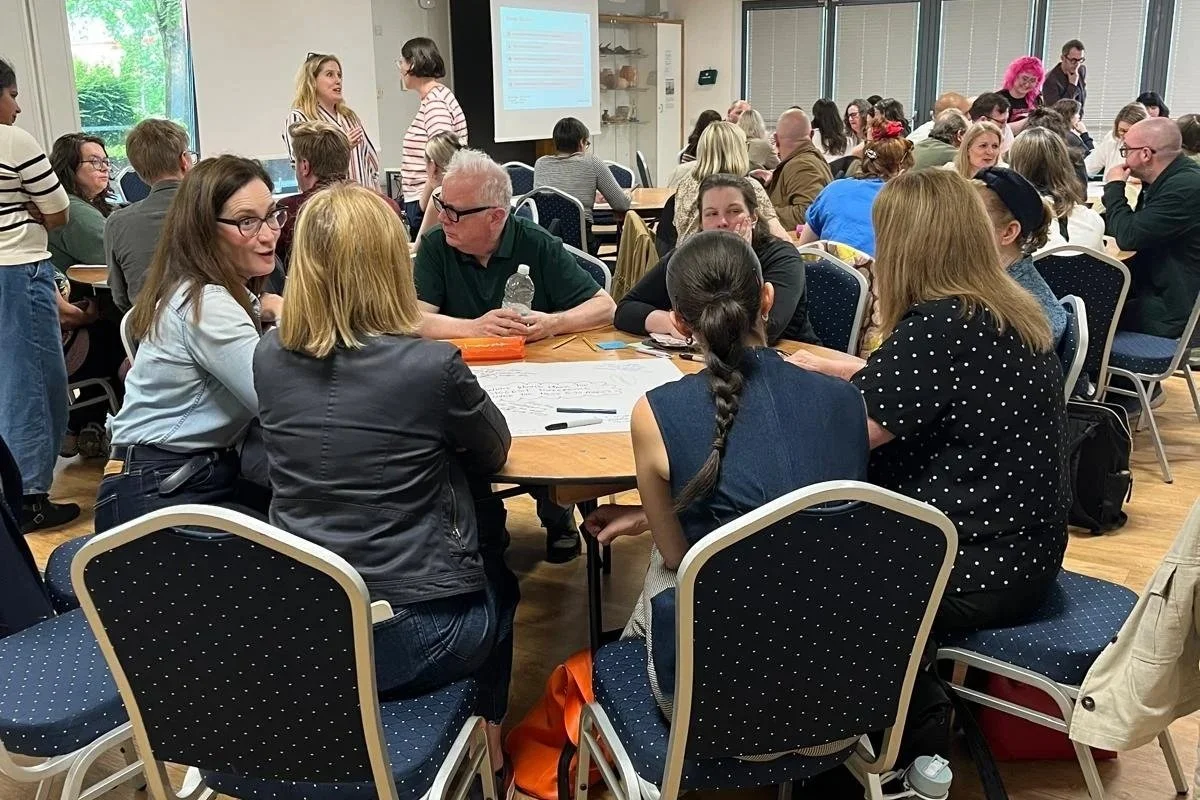
It’s the morning after our third Newcastle Culture Partnership event. The event at Great North Museum: Hancock asked people to share their thoughts on the North East Mayoral Strategic Authority’s draft framework for Culture, Creative Industries and Sport.
Now here I am, balancing on a yellow stool in Unfolding Theatre office, trying to take a photo that contains all of the handwritten notes. Even reaching as high as I can, I can’t fit them all in.
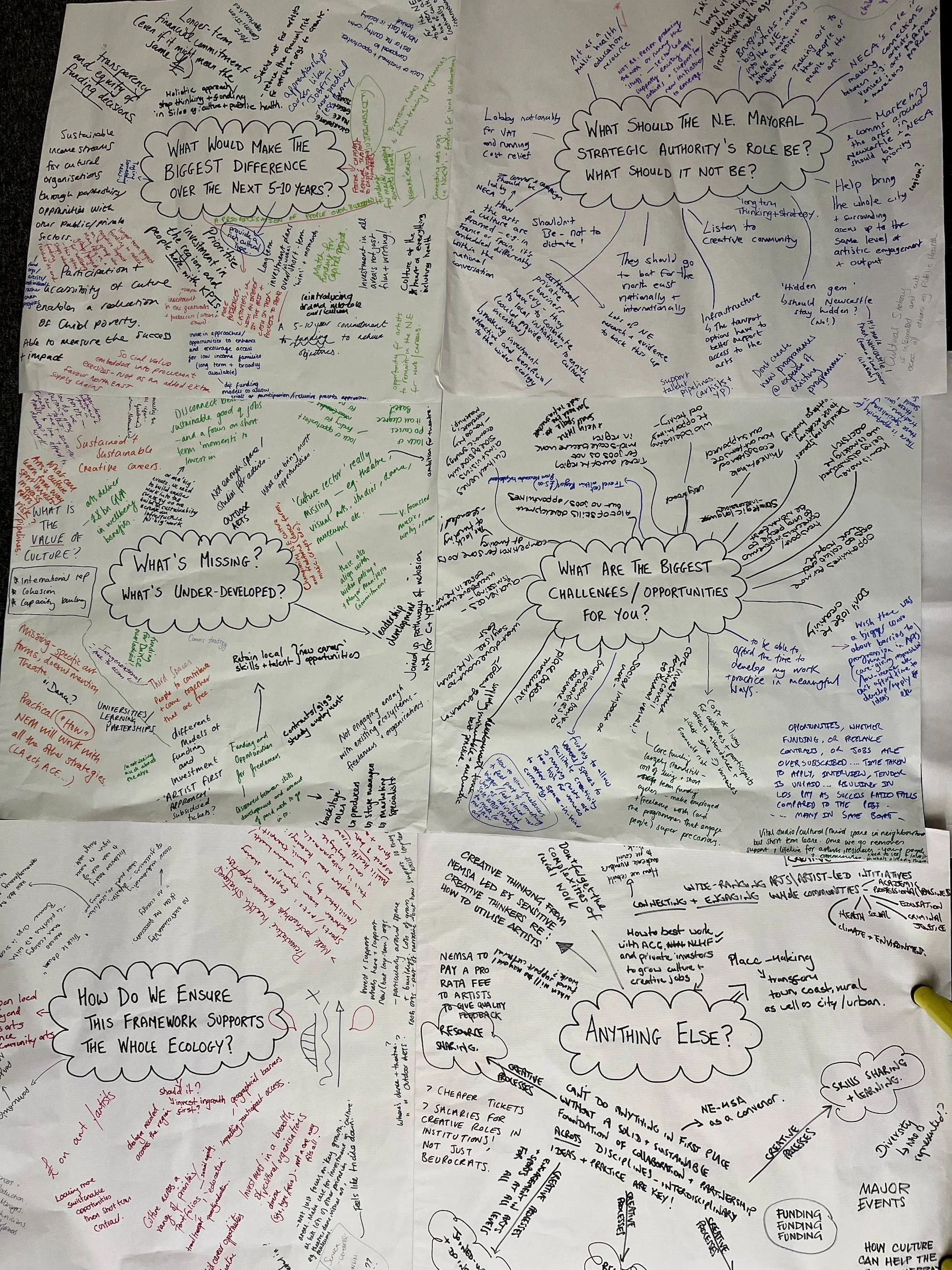
I’m not attempting to digest all the notes here. Sarah Hughes and Mark Adamson from NE Mayoral Strategic Authority took their own photos, notes and memories of conversations and have worked up a summary below. Instead, I am reflecting on things I noticed.
First of all, it’s the very fact that there’s a lot. I felt that in the room too. There’s a lot to say. Lots of voices, ideas and challenges. Lots of thought, care - frustration too - and desire to make things better for culture and communities in the North East.
I feel energised by how often conversations circled back to the artists and freelancers who make up the majority of our workforce, but are often the most precarious part of the ecology. I hope this recurring theme will translate into action that improves conditions, and in turn sparks vibrant, confident and distinct North East creativity.
The need to strengthen collaboration ran through many conversations. As did investing in community engagement and inclusion. The challenge of how ‘success’ is measured was raised. As well as long-term thinking, and the distinctiveness of place.
I was struck by the honesty in the room. Keith Merrin set a useful context noting that the Mayoral Strategy is born out of the government’s Industrial Strategy. This positions the majority of investment into what is most likely to deliver high economic growth. This sparked really interesting conversations.
I thought about Unfolding Theatre - the company I founded nearly 18 years ago. I can’t promise we’re going to deliver millions to the Treasury any time soon. But I am confident we’ve built a resilient business that will still be making theatre, engaging audiences and employing people as the years go by. I know many organisations that could say the same.
And that circles back to the value of culture. Keith gave the example of the child that visits a museum and sees something that sparks an interest that opens up a path that shapes their life. We are all part of an ecology. Museums, community centres, theatres, individual practitioners, galleries, studios. It’s not always easy to predict what will lead where. But the stronger the ecology, the more will grow.
If you weren’t able to join us, there’s still time to contribute to the North East Mayoral Strategic Authority’s consultation online. You can share your thoughts here until 17th June. You can also contact Project Manager, Sarah Hughes directly here.
Another blog post on this event will follow shortly, from creative freelancer Adam Goldwater.
And if you’d like more detail on yesterday’s discussions than I managed via the photo taken while balanced on a yellow stool, here’s Sarah and Mark’s summary.
Newcastle Culture Partnership Consultation
Summary of Discussion Themes
Overview
Participants broadly welcomed the ambition to develop a regional Culture, Creative Industries and Sport Strategic Framework and recognised the opportunity presented by devolution and the role of the North East MSA.
However, there was a strong message that the framework should focus on creating the conditions for the sector to thrive, rather than directing activity. Participants emphasised the importance of supporting the whole cultural ecology, including freelancers, artists, micro-businesses, grassroots organisations and communities.
Culture, Identity and Place
Key Messages
Participants consistently highlighted the role of culture in shaping identity, pride and belonging across the region.
There was a strong desire to celebrate the North East’s distinctive assets, stories, people and places, while avoiding a one size fits all regional narrative.
Discussion points
Culture plays a critical role in place making and regeneration
The framework should celebrate local distinctiveness and the diversity of places across the North East
More emphasis should be placed on ‘voice’, local identity and community storytelling
Cultural activity should help people seem themselves reflected in the region
The North East needs visible and authentic cultural ambassadors and role models
Culture should support towns, coastal communities and rural areas as well as major cities
Summary
Participants saw culture as fundamental to regional identity and place-making. The framework should articulate culture’s role in helping communities understand, celebrate and shape the places they live.
Supporting the Whole Cultural Ecology
Key Messages
One of the strongest themes was the need to recognise and support the entire cultural ecosystem, not only larger organisations and flagship institutions.
Discussion Points
Freelancers are critical to the sector but often overlooked
Artists and creative practitioners should be recognised as drivers, facilitators and innovators
Micro-businesses and SMEs are the lifeblood of the creative economy
The framework should acknowledge the interconnected nature of organisations, artists, communities and audiences
Participants expressed concern about over reliance on a small number of organisations or programmes.
Summary
There was strong support for an ecosystem approach that recognises the contribution of freelancers, artists, creative businesses, community organisations and cultural institutions alike.
Skills, Talent and Career Pathways
Key Messages
Skills, talent development and retention emerged as major priorities.
Discussion Points
Better pathways are needed from education into creative careers
Concerns were raised about talent leaving the region
Participants questioned where responsibility currently sits for skills development
More mapping of existing provision and gaps was suggested
Greater collaboration between education providers, industry and cultural organisations is needed
There was support for stronger investment in creative job opportunities
Summary
Participants felt the framework should place greater emphasis on talent pipelines, skills development and creating sustainable career opportunities within the region.
Long Term Investment and Financial Sustainability
Key Messages
Funding was one of the most frequently discussed issues.
Discussion Points
Calls for longer term funding settlements
Greater transparency in funding decisions
More equitable distribution of investment
Sustainable income models rather than short term project funding
Better alignment between culture, health, education and economic development funding
Recognition that financial stability is essential to achieving long term outcomes
Summary
Participants argued that the biggest difference over the next 5-10 years would come from longer term, more sustainable investment models that provide certainty and enable strategic planning.
Access, Participation and Inclusion
Key Messages
Participants wanted inclusion to be embedded throughout the framework.
Discussion Points
Reducing barriers to participation
Supporting low-income communities
Tackling cultural poverty
Ensuring access across different geographies and communities
Recognising the value of culture for wellbeing and quality of life
Improving accessibility for audiences and participants
Summary
There was broad agreement that culture should be viewed as a public good and that increasing participation and reducing inequalities should remain central objectives.
Collaboration, Partnership and Networks
Key Messages
The importance of partnership working was repeatedly emphasized.
Discussion Points
Better connections between organisations
Increased collaboration across sectors
Stronger relationships between culture, health, education and economic development
Sharing knowledge, resources and learning
Creating opportunities for collective action rather than competition
Summary
Participants saw the MSA as having an important role in convening partners and creating conditions for collaboration.
Role of the North East MSA
Key Messages
There was substantial discussion about what the MSA’s role should be.
The MSA Should:
Provide strategic leadership
Advocate nationally and internationally for the region
Convene partners and broker relationships
Support collaboration
Invest in infrastructure and enabling conditions
Promote the regions cultural strengths
Listen to and work alongside the creative community
Take a long-term view
The MSA Should Not:
Dictate artistic priorities
Duplicate existing programmes
Become overly bureaucratic
Centralise decision making
Replace existing sector expertise
Summary
Participants were clear that the MSA’s role should be one of leadership, advocacy, convening and enabling rather than direct control.
Infrastructure and Enabling Conditions
Key Messages
Participants highlighted the need for stronger cultural infrastructure.
Discussion Points
Physical cultural spaces and venues
Transport and connectivity
Digital infrastructure
Skills infrastructure
Organisational resilience
Support structures for freelancers and microbusinesses
Summary
The framework should focus on creating the conditions that allow culture and creativity to flourish rather than simply funding activity.
Measuring Value and Impact
Key Messages
Participants felt that the value of culture is often misunderstood or underrepresented.
Discussion Points
Need to better articulate culture’s contribution
Recognition of social, health and community impacts alongside economic impacts
Importance of measuring outcomes and impact
Better evidence to support investment decisions
Summary
There was support for a broader definition of value that recognises cultural, social and economic benefits
Sector Priorities and Areas for Further Development
Discussion Points
Participants identified several areas where the framework could be strengthened.
Greater focus on freelancers
Stronger emphasis on creative careers and workforce development
More explicit consideration of publishing, music and screen sectors
Clearer articulation of cultural identity and place
Stronger recognition of artists as catalysts for change
Better understanding of existing provision before developing new initiatives
Mapping exercises to identify gaps, duplication and opportunities
Summary
Participants generally supported the framework’s direction but felt it could go further in recognising the realities of the cultural sector and the importance of supporting the wider creative ecology.
Overall Conclusion
The consultation demonstrated strong support for a regional strategic framework. Participants welcomed the opportunity for greater collaboration, advocacy and investment through the MSA.
The strongest messages were the need to:
Support the whole cultural ecology, including freelancers and micro businesses
Invest in skills, talent and career pathways
Provide longer-term and more sustainable funding
Strengthen culture’s role in place, identity and community wellbeing
Position the MSA as a strategic leader, advocate and convenor
Create the conditions for culture to thrive rather than directing cultural activity
Participants were clear that the framework should be ambitious, inclusive and rooted in the realities of the sector, while recognising culture as a driver of economic, social and civic value across the region.